
Norristown High Speed Line
69th Street Transit Center to Norristown Transit Center · 22 stations · 28 min end to end
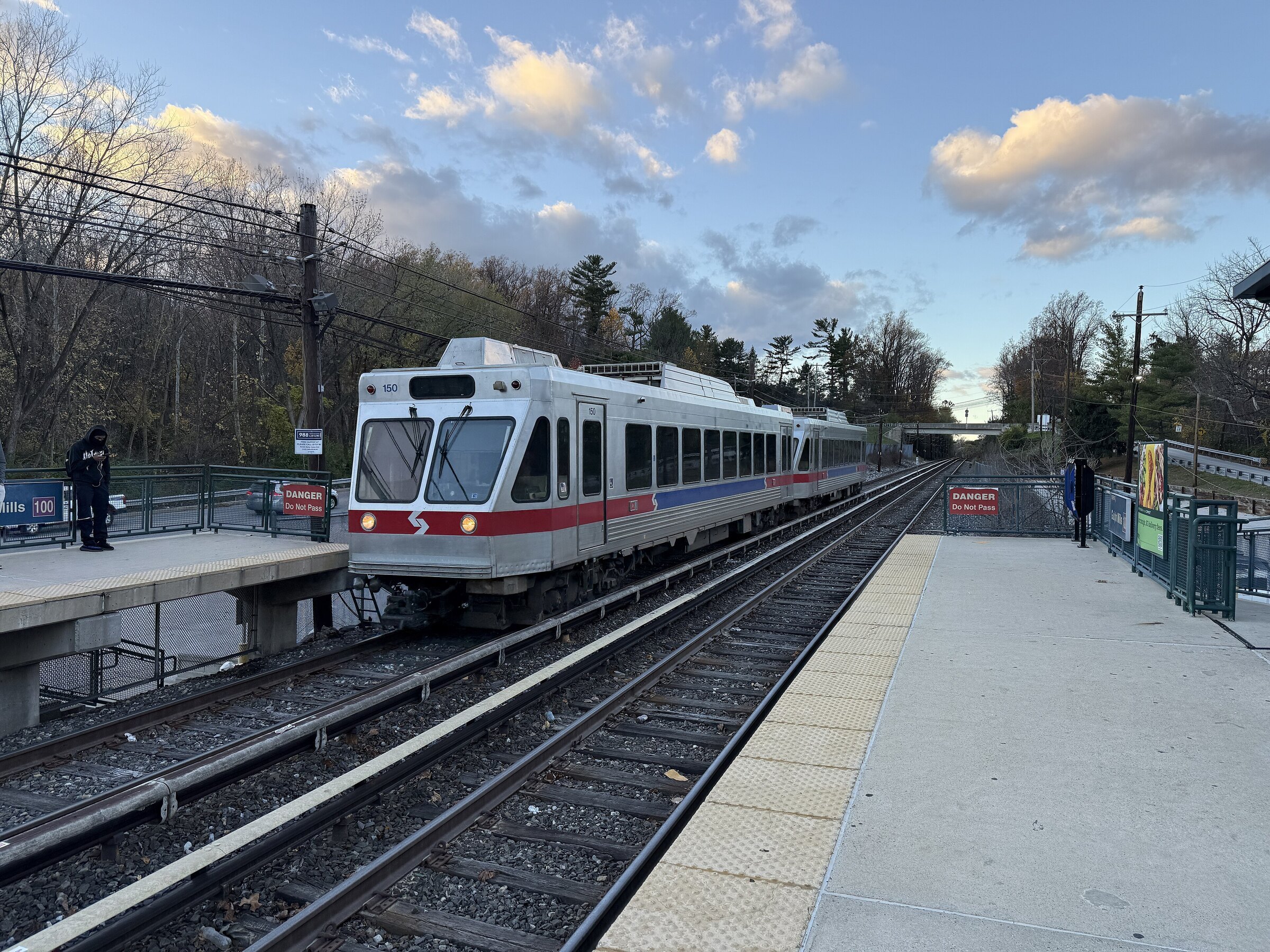
The Norristown High Speed Line is not an urban subway and it is worth saying so before you plan around it. It is a fully segregated interurban railway: 22 stations over 13.4 mi (21.56 km), out of 69th Street Transit Center through Delaware County and up into Montgomery County to Norristown Transit Center. Most of its stops are small suburban platforms, not city stations.
The practical difference is the wait. In the weekday peak a train comes about every 15 min, which is a normal metro frequency — but in the middle of the day it drops to every 30 min, so turning up and hoping is a bad plan. It is also the one line on this network whose running trains are visible in the live feed, which is why the service panel can show a next train for the M and not for the other two.
The line in pictures
Every stop on the Norristown High Speed Line
In running order, from 69th Street Transit Center to Norristown Transit Center. A ring marks a station where another line stops too — and there, the platforms are separate.
Stop on this lineEnd of the lineTransfer, different platform
69th Street Transit Center → Norristown Transit Center
22 stations · 13.4 mi (21.56 km) · 29 min end to end
How often trains run
Typical gap between trains in each part of the day, in the first direction of travel.
| Service | Day | Early morning before 7 am | Morning peak 7–9:30 am | Midday 9:30 am – 3:30 pm | Afternoon peak 3:30–6:30 pm | Evening 6:30–9 pm | Late night after 9 pm |
|---|---|---|---|---|---|---|---|
| Norristown High Speed Line Local | Monday to Friday | every 15 min | every 15 min | every 30 min | every 15 min | every 20 min | every 34 min |
| Norristown High Speed Line Local | Saturday | every 20 min | every 20 min | every 20 min | every 20 min | every 30 min | every 45 min |
| Norristown High Speed Line Local | Sunday | every 35 min | every 30 min | every 30 min | every 30 min | every 30 min | every 45 min |
| Norristown High Speed Line Local | Holiday service | every 35 min | every 30 min | every 30 min | every 30 min | every 30 min | every 45 min |
First and last train
Departures from the end of the line. Times after midnight are marked, because this timetable runs past it — the last trains of the night leave after 2 am.
| Service | Day | Direction | First train | Last train | Trips |
|---|---|---|---|---|---|
| Norristown High Speed Line Local | Monday to Friday | towards Norristown Transit Center | 4:06 am | 1:40 am (next day) | 63 |
| Norristown High Speed Line Local | Monday to Friday | towards 69th Street Transit Center | 4:39 am | 2:12 am (next day) | 63 |
| Norristown High Speed Line Local | Saturday | towards Norristown Transit Center | 4:40 am | 1:42 am (next day) | 54 |
| Norristown High Speed Line Local | Saturday | towards 69th Street Transit Center | 5:20 am | 2:16 am (next day) | 54 |
| Norristown High Speed Line Local | Sunday | towards Norristown Transit Center | 4:45 am | 1:42 am (next day) | 40 |
| Norristown High Speed Line Local | Sunday | towards 69th Street Transit Center | 5:20 am | 2:15 am (next day) | 40 |
| Norristown High Speed Line Local | Holiday service | towards Norristown Transit Center | 4:45 am | 1:42 am (next day) | 40 |
| Norristown High Speed Line Local | Holiday service | towards 69th Street Transit Center | 5:20 am | 2:15 am (next day) | 40 |
Where you can change lines
Three places on this network have two lines under one name. In all three the platforms are separate.
| Station | Change to | Platforms | Walking time |
|---|---|---|---|
| 69th Street Transit Center | L | different platforms | not published |
Stations on this line without full step-free access
| Station | What the data says |
|---|---|
| Parkview | No step-free access |
| Township Line Road | No step-free access |
| Penfield | No step-free access |
| Beechwood-Brookline | Step-free on some platforms only |
| Ardmore Junction | No step-free access |
| Haverford South | No step-free access |
| Bryn Mawr South | No step-free access |
| Roberts Road | No step-free access |
| Garrett Hill | No step-free access |
| Villanova South | Step-free on some platforms only |
| Radnor South | Step-free on some platforms only |
| County Line | No step-free access |
| Matsonford | No step-free access |
| Hughes Park | No step-free access |
| DeKalb Street | No step-free access |
| Bridgeport | Step-free on some platforms only |
Across the whole network 42 of the 70 stations are declared step-free, 23 are not and 5 have platforms declared differently from each other. The accessibility page has the full table and the lift and stair counts for the six biggest complexes.
Questions about the Norristown High Speed Line
22, from 69th Street Transit Center to Norristown Transit Center. They are all listed above in running order, each one linked to its own page with first and last train and what is nearby.
28 min one way and 29 min the other, measured as the last arrival minus the first departure of a complete trip — not as a sum of the gaps between stations, which is where other guides lose minutes.
On a weekday the first train is at 4:06 am and the last leaves at 2:12 am (next day). The schedule page has all four kinds of day, including the two holidays that get a timetable of their own.
$2.90, the same on every line and whatever you pay with. Two of the four ways to pay also give you up to 2 free transfers within 2 hours; the other two do not. The fares page says which is which.
No. It is a segregated interurban railway out to the suburban counties. It uses the same kind of right of way as a metro, but the stops are small suburban platforms and the midday wait is about 30 min, not the 6 min you get on the two city lines.
These are the scheduled times, read from the published open data and recomputed every day. The service panel on the front page adds service notices on top of them.